Ancient Asteroid 20 Times Larger Than the One That Wiped Out the Dinosaurs Likely Struck Jupiter’s Moon Ganymede
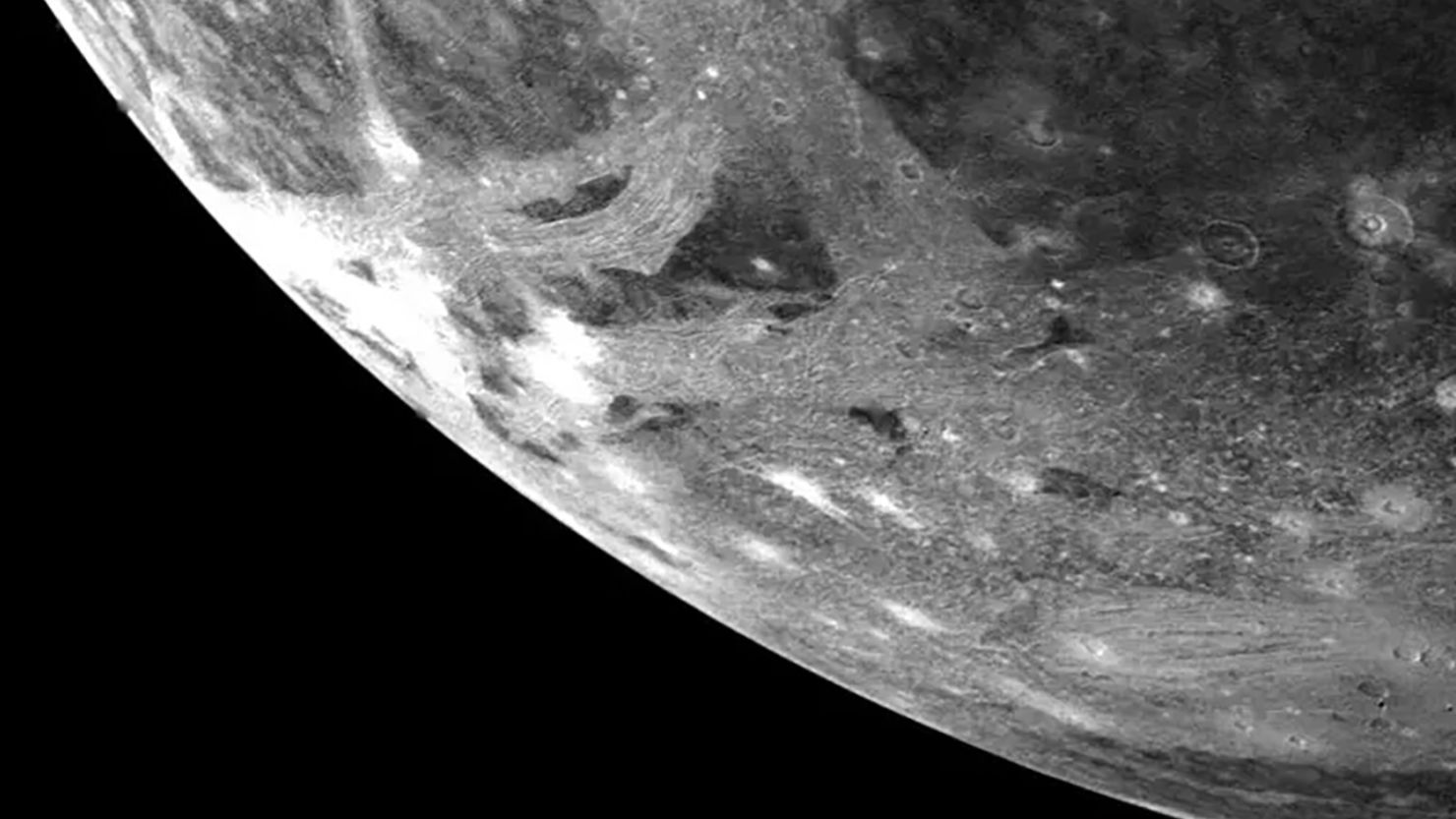
Ancient Asteroid 20 Times Larger Than the One That Wiped Out the Dinosaurs Likely Struck Jupiter’s Moon Ganymede
Scientists have long been fascinated by Jupiter’s moon Ganymede, the largest moon in our solar system, with a diameter larger than even the planet Mercury. Recent research has unearthed a staggering revelation: an ancient asteroid, 20 times larger than the one that caused the extinction of the dinosaurs, may have impacted Ganymede millions or even billions of years ago, leaving a significant mark on the moon’s surface and potentially shaping its geological history.
A Colossal Collision
Ganymede’s surface, known for its dramatic tectonic and ice-crusted landscape, bears evidence of an impact that dwarfs many others in the solar system. The asteroid believed to have hit the moon was estimated to be over 200 kilometers (124 miles) in diameter. For comparison, the asteroid that wiped out the dinosaurs on Earth was around 10-15 kilometers (6-9 miles) in diameter, and yet it caused mass extinction and forever altered Earth’s ecosystems.
The discovery was made by planetary scientists studying Ganymede’s massive craters and surface features. Researchers believe that this asteroid impact may have occurred billions of years ago when the solar system was still young, and collisions between large celestial bodies were more frequent. The impact would have released an immense amount of energy, reshaping the moon’s surface, and leaving behind a scar that can still be observed today.
Studying Ganymede’s Impact Crater
Ganymede is no stranger to impacts. Its surface is littered with craters, some of which are among the largest in the solar system. However, one particular impact basin stands out as a possible candidate for this colossal asteroid collision. This feature, known as the Valhalla impact basin, spans approximately 3,800 kilometers (2,360 miles) in diameter, making it one of the largest known impact structures in the solar system.
Valhalla is characterized by concentric rings of fractures radiating outward from its center, suggesting that an enormous force struck Ganymede at some point in the distant past. The sheer size and complexity of Valhalla make it a prime candidate for the site of this ancient asteroid impact. While it’s not definitively proven that this is where the asteroid landed, the scale of the crater supports the hypothesis of a massive collision.
This impact likely caused intense geological activity on Ganymede. The force of the collision may have cracked the moon’s icy crust, possibly leading to the formation of some of its unique tectonic features, including grooved terrains and fault lines. Beneath the ice, Ganymede is believed to have a vast subsurface ocean. It’s possible that the asteroid’s impact could have stirred this ocean, leading to chemical reactions that might have affected the moon’s composition and geology.
Comparing the Impacts: Ganymede vs. Earth
The asteroid that struck Earth 66 million years ago left the infamous Chicxulub crater in Mexico’s Yucatán Peninsula. This impact was so powerful that it triggered a mass extinction event, wiping out about 75% of all species on Earth, including the non-avian dinosaurs. The energy released by the Chicxulub impact was equivalent to billions of atomic bombs.
Now, imagine an asteroid 20 times larger than that. The energy released from such an impact would have been incomprehensibly greater, but Ganymede’s vast size and icy composition might have absorbed some of the shock. Unlike Earth, Ganymede does not have an atmosphere, which would have amplified the devastation on Earth due to firestorms and environmental fallout. On Ganymede, however, the direct effects would have been more localized to the moon’s surface.
The impact likely released immense amounts of heat, possibly creating temporary liquid water on the surface. While the impact would not have caused the same kind of extinction event as Chicxulub, it would have forever altered Ganymede’s topography, creating the enormous basins and fractures we observe today.
Implications for Ganymede’s Geological History
The discovery of such a large impact event on Ganymede provides valuable insights into the moon’s geological history. Ganymede is unique in that it has its magnetic field, a trait not shared by many other moons. This has intrigued scientists for years, and understanding its past, particularly the history of massive collisions, could help explain how Ganymede’s magnetic field developed.
The idea that large impacts could influence a moon’s geology is not new. Similar impacts on Earth’s Moon and on Mars are believed to have played significant roles in shaping their respective surfaces. On Ganymede, the colossal asteroid could have triggered significant geological processes, possibly contributing to the formation of the moon’s extensive grooved terrain—a feature that differentiates it from other icy moons like Europa and Callisto.
In addition, studying Ganymede’s ancient impacts can offer clues about the solar system’s early history. The period when this asteroid likely struck was characterized by frequent collisions between protoplanets, moons, and asteroids, shaping the celestial bodies we see today. Understanding these impacts could help scientists reconstruct the events that led to the formation of Ganymede and other large moons and planets in the outer solar system.
A Glimpse into the Future
Jupiter’s icy moons, including Ganymede, have captured the interest of scientists and space agencies alike. NASA’s upcoming Europa Clipper mission and the European Space Agency’s JUICE (Jupiter Icy Moons Explorer) mission aim to explore Ganymede, Europa, and Callisto in greater detail. These missions will gather data that could confirm or challenge theories about Ganymede’s ancient asteroid impact and its geological evolution.
As we prepare to explore these distant moons more closely, understanding Ganymede’s history of massive collisions could also shed light on the potential for habitability in icy moons. While Ganymede’s vast subsurface ocean is unlikely to support life as we know it, understanding the moon’s history of heat generation and geological activity could reveal insights into how water and heat interact in extreme environments.
Conclusion
The discovery of an ancient asteroid impact, 20 times larger than the one that wiped out the dinosaurs, striking Ganymede, is a testament to the immense forces that shaped our solar system. While Earth’s history was altered dramatically by the Chicxulub impact, Ganymede’s encounter with a far larger asteroid left an indelible mark on its surface, reshaping its icy landscape and providing clues about the moon’s ancient past.
As future missions explore Ganymede’s surface and subsurface, we may uncover even more about the moon’s dynamic geological history and its place in the broader story of our solar system.