Massive Jets from Black Holes: Dwarfing Even the Largest Galaxies
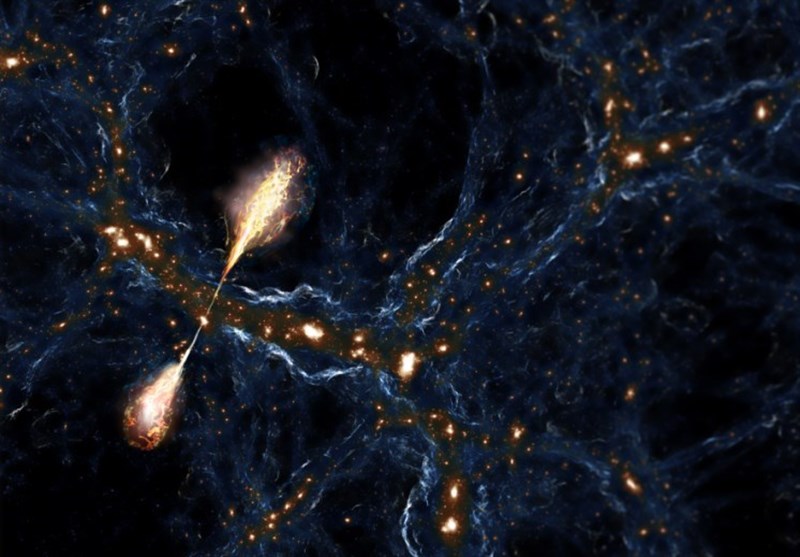
In the vastness of the universe, black holes remain some of the most enigmatic and powerful entities known to science. Recent observations have revealed that these cosmic giants are capable of producing massive jets of material that can dwarf even the largest galaxies. These jets, often stretching for thousands of light-years, challenge our understanding of physics and the dynamics of galaxy formation and evolution.
The Phenomenon of Black Hole Jets
Black holes, particularly the supermassive ones found at the centers of galaxies, can create extraordinarily energetic jets that shoot out into space. These jets are formed when material, often from surrounding gas and dust, spirals into the black hole’s accretion disk—a rotating disk of matter that is heated to extreme temperatures as it approaches the event horizon. The intense gravitational and magnetic forces in this region can propel some of this material away from the black hole at nearly the speed of light, creating jets that extend far beyond their host galaxies.
One of the most striking features of these jets is their ability to produce high-energy emissions across the electromagnetic spectrum, from radio waves to X-rays and even gamma rays. This means that they can be detected by various types of telescopes and observatories, allowing astronomers to study their properties and behaviors in great detail.
Jets That Dwarf Galaxies
Recent studies have shown that some black hole jets can extend several thousand light-years into space, making them far larger than the galaxies they inhabit. For instance, the jets emitted by supermassive black holes can be observed in galaxy clusters, where they can create vast cavities in the surrounding hot gas, affecting the thermal dynamics of the cluster itself.
A prominent example is the giant radio galaxy 3C 348, where jets from a supermassive black hole stretch for more than a million light-years, dwarfing its host galaxy. These jets not only illuminate the universe with their high-energy emissions but also play a significant role in the evolution of their host galaxies and the intergalactic medium. The energy and material ejected by the jets can influence star formation, galaxy mergers, and the distribution of dark matter.
The Role of Magnetic Fields
One of the critical factors contributing to the formation of these massive jets is the presence of magnetic fields around the black hole. The interactions between the accretion disk and these magnetic fields can funnel particles away from the black hole in highly collimated jets. The complex dynamics of these processes remain an active area of research, as scientists strive to understand the precise mechanisms that lead to jet formation.
The strength and configuration of magnetic fields are influenced by various factors, including the black hole’s mass, the rate at which it accretes matter, and the environment surrounding the black hole. As such, each black hole may produce jets with unique characteristics, ranging from their size and shape to their composition and energy output.
Observing the Unobservable
Observing the jets from black holes presents significant challenges for astronomers. While we cannot see black holes directly, their jets can be detected using radio telescopes and observatories that specialize in high-energy astrophysics. Instruments like the Event Horizon Telescope (EHT), which famously captured the first image of a black hole’s shadow in 2019, are now being used to study the intricate details of these jets.
By analyzing the emissions from the jets, scientists can infer crucial information about the black hole’s mass, spin, and the properties of the material being ejected. The recent advancements in observational technology have allowed researchers to detect jets in increasingly distant galaxies, leading to a better understanding of the role black holes play in cosmic evolution.
Implications for Galaxy Formation and Evolution
The jets from black holes are more than just fascinating cosmic phenomena; they have significant implications for our understanding of galaxy formation and evolution. As these jets interact with the surrounding gas and dust, they can regulate star formation rates within their host galaxies, either triggering or suppressing the formation of new stars.
For instance, in some cases, the energy from the jets can heat the surrounding gas, preventing it from collapsing to form new stars. Conversely, in other situations, the jets can inject energy and momentum into the interstellar medium, stirring it up and potentially leading to new star formation. This dual role highlights the complexity of black hole-galaxy interactions and underscores the need for further research in this area.
The Future of Black Hole Research
As technology continues to advance, our ability to study black holes and their jets will improve dramatically. Upcoming observatories, such as the James Webb Space Telescope (JWST) and the next generation of radio arrays, will provide unprecedented insights into the behavior of black holes and their jets.
Researchers are eager to explore questions such as: How do jets influence the growth and evolution of galaxies? What are the physical conditions in the regions surrounding black holes? And how do these jets impact the larger structure of the universe?
With every discovery, we move closer to unraveling the mysteries surrounding black holes and their jets, providing deeper insights into the nature of the universe itself.
Conclusion
Massive jets emitted from black holes are some of the most awe-inspiring phenomena in the cosmos, dwarfing entire galaxies and offering a glimpse into the power of these enigmatic entities. As we continue to study these jets, we not only enhance our understanding of black holes but also gain valuable insights into the formation and evolution of galaxies. The universe is filled with mysteries, and black holes and their jets remain at the forefront of our quest for knowledge, reminding us of the complexity and beauty of the cosmos.