Turkmenistan’s Mysterious Flaming ‘Gates of Hell’: The Fiery Crater That Won’t Stop Burning
Turkmenistan’s Mysterious Flaming ‘Gates of Hell’: The Fiery Crater That Won’t Stop Burning
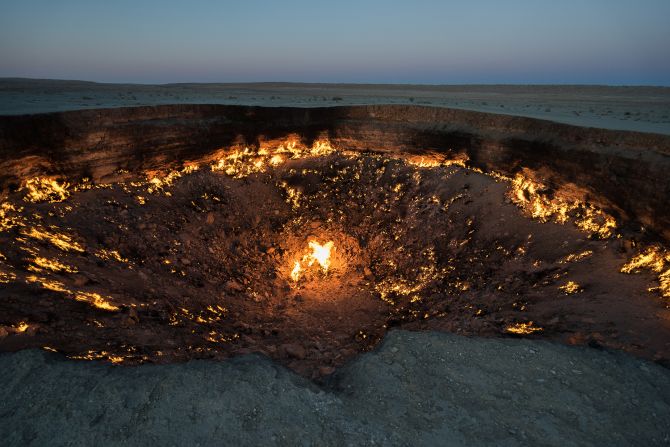
In the heart of the Karakum Desert in Turkmenistan lies a blazing, otherworldly spectacle that has captivated the imagination of visitors and scientists alike for decades. Known as the “Gates of Hell,” this flaming crater has been burning continuously for over 50 years, casting an eerie glow across the barren landscape and earning its place as one of the world’s most mysterious and intriguing natural phenomena.
The Origins of the Gates of Hell
The origins of the Darvaza gas crater, as it is officially known, date back to 1971 when Soviet geologists were exploring the region for natural gas deposits. Turkmenistan, rich in natural gas, was an attractive site for drilling, and the Soviet team was eager to tap into what they believed was a vast underground reserve.
However, things didn’t go as planned. The drilling rig punctured a massive underground cavern filled with natural gas, causing the ground beneath it to collapse. This sudden event created a large crater, approximately 70 meters (230 feet) wide and 20 meters (65 feet) deep. The collapse released dangerous quantities of methane gas into the atmosphere, posing a significant environmental and safety hazard.
Why the Crater Was Set on Fire
Fearing the potential spread of the toxic gas, the geologists decided to ignite it, hoping the fire would consume the gas in a matter of days. This was a common practice at the time, known as “flaring,” where excess gas is burned off to prevent environmental damage. However, what was expected to be a brief flare-up turned into a seemingly eternal blaze. The gas has been burning ever since, and no one knows exactly how much is left to fuel the fire.
The Flaming Crater Today
Over the years, the Darvaza gas crater has become a strange and compelling landmark, drawing in tourists, adventurers, and scientists from around the world. The fire inside the crater burns continuously, with flames leaping up from the crater’s edge and casting a fiery orange glow against the night sky. The heat is intense, and the acrid smell of burning gas is a constant reminder of the powerful forces at play beneath the earth’s surface.
Locals dubbed the site “The Gates of Hell” due to its menacing appearance and the fact that, for decades, it has looked like a portal to some fiery underworld. Despite its ominous name, the crater has become one of Turkmenistan’s most popular tourist attractions, though reaching it requires a journey across the remote and harsh desert terrain.
Scientific and Environmental Significance
The Darvaza gas crater is not just a curiosity; it also holds scientific significance. It provides a rare opportunity to study the behavior of long-term gas fires and the effects of burning methane on the environment. Methane is a potent greenhouse gas, and while flaring was meant to prevent its release into the atmosphere, the continuous burning at Darvaza raises questions about the overall environmental impact of the site.
Researchers have studied the crater to better understand how such fires might be safely extinguished, though no viable solution has been found so far. The site also serves as a stark reminder of the risks associated with fossil fuel extraction and the potential for unforeseen consequences.
A Future Uncertain
In recent years, the Turkmen government has considered extinguishing the fire, citing environmental and safety concerns. In January 2022, President Gurbanguly Berdimuhamedow called for efforts to put out the fire, citing the need to use the natural gas for economic purposes rather than letting it burn away. However, as of now, no definitive plan has been implemented, and the Gates of Hell continue to burn.
For now, the future of the Darvaza gas crater remains uncertain. Whether it will continue to burn for another 50 years or be extinguished in the near future, it stands as a powerful symbol of nature’s unpredictability and the unintended consequences of human intervention.
Conclusion: A Fiery Wonder
The Gates of Hell in Turkmenistan is one of the world’s most unusual and mesmerizing sights. This flaming crater, born out of a drilling accident, has become an enduring symbol of the delicate balance between nature and human activity. As it continues to burn, the site attracts the curious and the brave, who journey across the desert to witness the inferno and stand on the edge of this man-made wonder.
While the fire’s eventual fate remains unknown, the Darvaza gas crater serves as a powerful reminder of the raw power hidden beneath the earth’s surface—and the unforeseen results that can arise when we attempt to harness it.