Scientists Store Entire Human Genome on ‘Memory Crystal’ That Could Survive Billions of Years
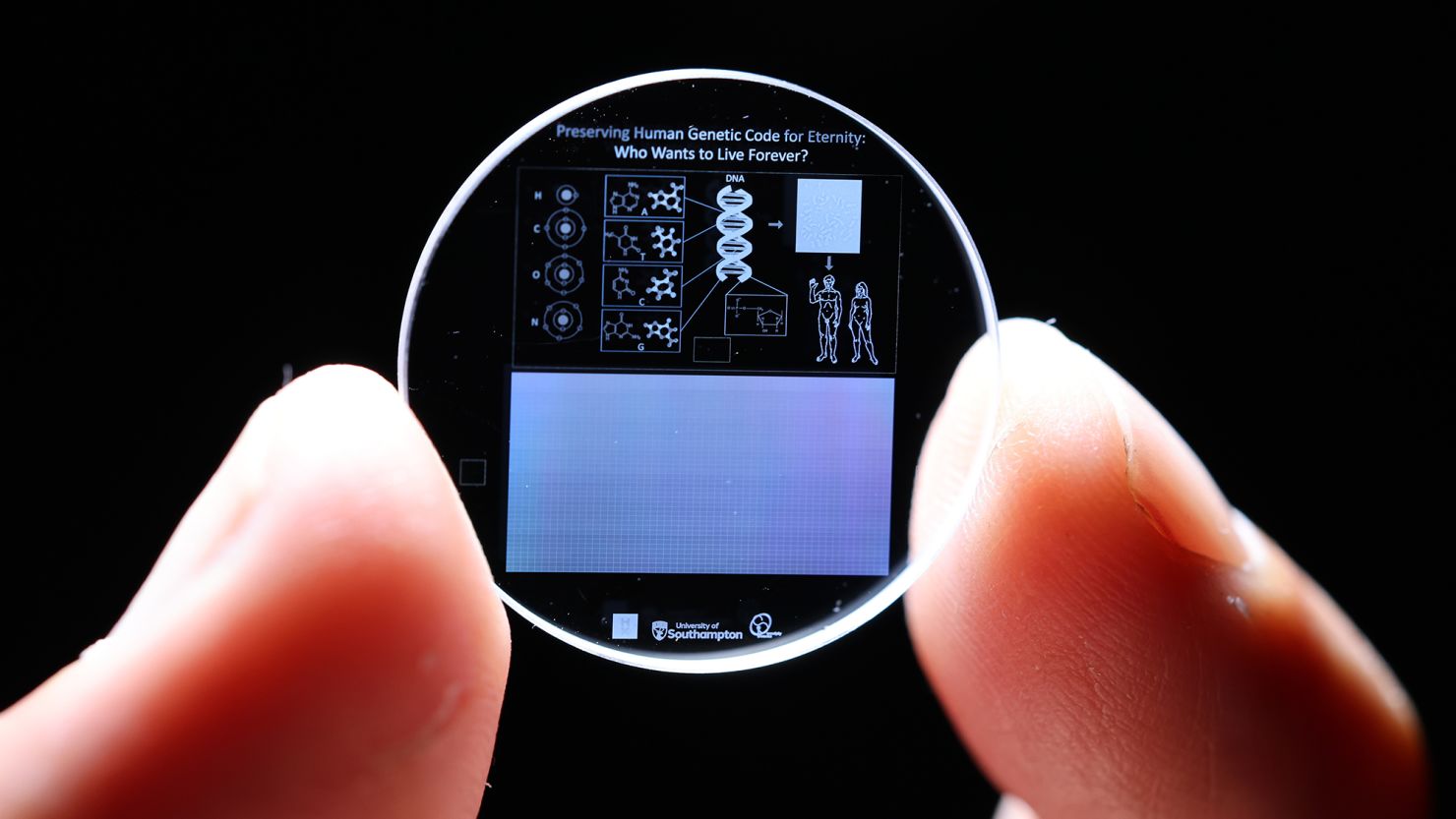
In a groundbreaking advancement, scientists have successfully stored the entire human genome on a futuristic “memory crystal,” a data storage device that could potentially last for billions of years. This new technology, known as 5D optical data storage, could revolutionize the way we preserve vast amounts of information, including human history, scientific discoveries, and even genetic blueprints, for future generations and civilizations.
What Is a ‘Memory Crystal’?
The memory crystal, made from nanostructured glass, is a type of 5D optical storage that uses five dimensions to encode information: the size and orientation of nanostructures inside the crystal, along with the three standard dimensions of space. Developed by researchers at the University of Southampton in the UK, this crystal can store data at densities far beyond those of traditional storage devices like hard drives or CDs.
This tiny disk-like crystal, measuring just a few centimeters in diameter, can hold up to 360 terabytes of data—equivalent to millions of books or entire archives of national libraries. However, its most striking feature is its durability. These crystals are capable of withstanding extreme temperatures and environmental conditions, meaning they could remain intact for billions of years, even in the vacuum of space.
Storing the Human Genome
The most recent achievement with this technology is the successful encoding of the entire human genome—about 3.2 billion DNA base pairs—into the memory crystal. The human genome, which contains all the genetic instructions that make up a human being, is one of the most complex and critical data sets ever sequenced. Storing this information in a format that could survive long into the future is seen as a monumental step forward in both science and technology.
By using femtosecond laser writing, the researchers were able to encode the human genome into the nanostructures of the glass, ensuring that it could be retrieved with near-perfect accuracy. The implications of this are enormous: in theory, this information could survive for billions of years, outlasting Earth’s current biosphere and serving as a record of human life for future civilizations.
The Promise of Longevity
One of the most exciting aspects of 5D data storage is its potential for longevity. Unlike traditional storage media, which can degrade over time due to environmental exposure or wear and tear, the memory crystal’s nanostructured glass is immune to such decay. In laboratory tests, researchers have demonstrated that the data stored in these crystals could withstand temperatures up to 1,000 degrees Celsius and remain stable for up to 13.8 billion years—the estimated age of the universe.
“The 5D memory crystals we have developed offer a virtually eternal solution for data storage,” said Professor Peter Kazansky, one of the researchers involved in the project. “We can store large volumes of information that could outlast humanity itself, ensuring that future generations, or even extraterrestrial civilizations, could access the knowledge we’ve accumulated.”
A New Era of Data Storage
This breakthrough could open the door to new possibilities for preserving humanity’s most important knowledge. In addition to the human genome, 5D memory crystals could store libraries of literature, scientific research, and cultural artifacts, preserving the entirety of human civilization in a form that could survive the test of time. They could also serve as time capsules, capturing the achievements and history of humanity for future generations to discover.
Organizations such as NASA have already expressed interest in the technology for potential use in space exploration. The durability and storage capacity of these crystals make them ideal for preserving data that might be needed on long-term missions to other planets or star systems. Unlike traditional storage devices, which may fail or degrade during interstellar travel, the memory crystal could endure the harsh conditions of space without losing any information.
The Implications for the Future
The potential uses for 5D memory crystals extend far beyond science and exploration. Governments and institutions could use the technology to safeguard critical information, ensuring that historical documents, treaties, and legal systems are preserved for future societies. Researchers envision using these crystals to store everything from climate data to medical records, ensuring that essential knowledge is not lost over time.
However, this breakthrough also raises questions about data management and accessibility. Storing vast amounts of data is only useful if future generations or civilizations have the means to retrieve it. Scientists are already working on developing readers that would allow future users to access the information stored in these crystals. They also envision creating a universal data retrieval system that could survive alongside the crystals.
The Dawn of a New Legacy
With the successful storage of the human genome on a memory crystal, humanity has taken a major step toward preserving its legacy for billions of years to come. This new technology has the potential to serve as the ultimate time capsule, carrying the story of human life and knowledge through the ages, no matter what happens to Earth or its inhabitants.
As researchers continue to refine the capabilities of 5D optical data storage, the dream of preserving our history and achievements for eternity is no longer the realm of science fiction but an emerging reality. Through the memory crystal, humanity may have found a way to ensure that its story endures, long after we are gone.